Showing posts with label Bermuda Puzzles. Show all posts

26 June 2019

DaYan's Bermuda Barrel

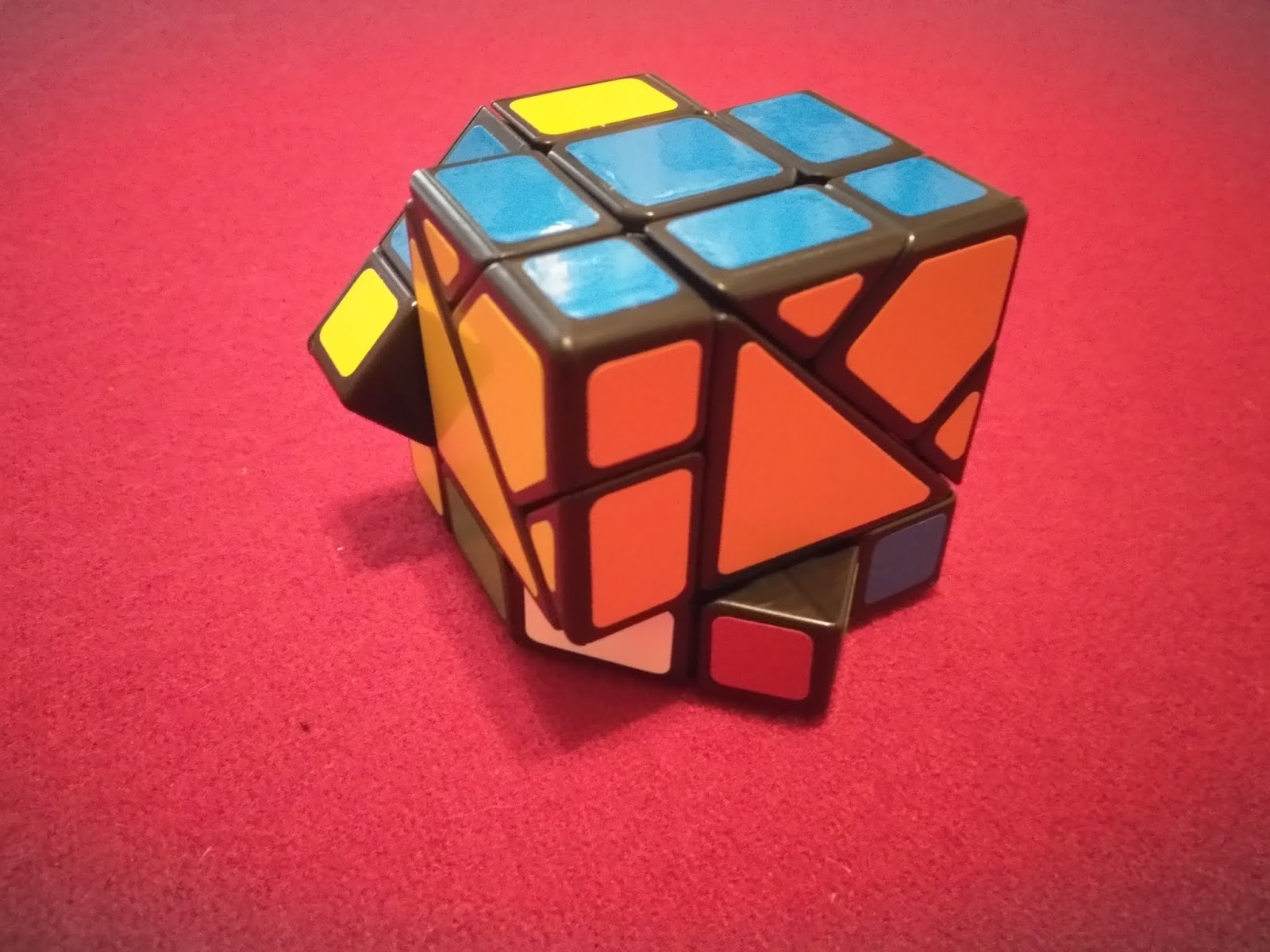
After completing my "Grand Tour" through the eight puzzles, named after the major planets in the Solar System, the next Bermuda puzzle I obtained was the barrel.

The puzzle is basically a shape modification of the Mercury cube. There is one Bermuda face, at the top of the barrel, on the green face. Cornering is not the best, compared with most Rubik's cubes, but better than most Bermuda puzzles. As I write this, have only experienced a popping problem once and I have had one of the covers of a triangular piece fall off. Some room for improvement in the design there, methinks.

Before my first solve, I neglected to take note of the configuration of the puzzle. I, therefore, had to figure out how it should look in the solved position. After completing the solve, I realised that it was in a different configuration from the one in which it arrived, The original had the white edge next to the hypotenuse of the green triangular centre the alternative is yellow.The puzzle is more nuanced than I had first realised.

The middle layer has square centres and square edges that, at first glance, are indistinguishable. This can make positioning the middle layer a little tricky during a solve.

Solved Configuration 1

The configuration in which I received the puzzle with the white edge on the hypotenuse
...

Solved Configuration 2

The alternative solved configuration with the yellow edge on the hypotenuse...


Solution

As explained above, there are a total of eight solutions to the puzzle. There are two green triangles with red sides. In the solved position, these two pieces are on either side of a 45° angle of the green triangular centre...


Step 1 - Solve the Green Face

Solve the green face, bearing in mind the green corners with red sides solve the green face.

The two red/green corners...


The solved side...


Step 2 - Solve the Middle Layer

This is slightly more tricky than it looks. At first glance, the centre pieces are indistinguishable from the edge pieces. The middle layer can be turned in half turns. This affects which vertical slices can be rotated: either the hypotenuse or the other two sides. The puzzle can be solved with either freedom of movement. However, the puzzle arrives with freedom of rotation on either side of the right angle.


Step 3 - Solve the Blue Corners

This is not difficult. The standard algorithms used with a normal cube work as long as you amend them to take into consideration the bandaging created by the green face's Bermuda-face.

It is possible that a parity issue could complicate matters. The two red/green corners will be helpful in solving this problem.

Step 4 - Solve the Blue Edges


The final step is to solve the blue edges. Again, not too challenging provided you take into consideration the bandaging of the green face.


30 March 2019

DaYan Neptune Bermuda Cube

After Uranus, I reached the end of my journey through the planets with Neptune. Neptune is similar to its predecessor; the difference being that there are three Bermuda faces instead of four. It is possible to rotate all three square centres; this introduces the possibility of a parity issue during the solve.

In the solved state, the right angles of the triangular centres all point to one corner. There are three degrees of freedom, on the blue, white and orange faces.


This makes it slightly easier to scramble than the previous two puzzles. The heavy bandaging means that cornering is not as easy as in some other puzzles. It is best to rotate the puzzle when the edges are rotated properly. I have not experienced any problems with popping.

If the puzzle of flipped over, it gives the illusion of a standard 3x3x3 puzzle.


As with other Bermuda puzzles, the integrity of the cubic shape is soon lost during the scramble.


Solution

By now the basic methodology for solving the Bermudas is well established. There is the additional complication of a possible parity issue.

I choose to focus on the yellow and white sides during the solve but any two opposites faces will work just as well, due to the symmetry of the puzzle.

Step 1 - Solve the Green/Red Edge

This is trivial. This will be the middle section of a Petrus-like block.


Step 2 - Solve the White Triangles and Pentagon

This can be done intuitively, though careful planning is needed to place the triangles. We now have a solved cubic section. It will be extended in the next step.


Step 3 - Solve the Yellow Corner and Edges bordering the Red and Green Faces

Again, this can be done intuitively.
This creates a Petrus-like block that gives freedom of movement on the blue and orange faces.


Step 4 - Solve the Blue and Orange Rectangles and Pentagons

First, rotate these pieces (they behave like edges). Solve the blue rectangles and check that the puzzle does not have a parity issue. If it is not possible to permutate all of the edges on the orange edge then the yellow square needs to be rotated by 90°.
Once all of the pieces are correct it is time to work on the corners. To facilitate this I rotate the blue face so that the right angle of the blue centre is pointing down.


Step 5 - Rotate the Orange and Blue Triangles and Squares

This is a little fiddly but once I had sussed out how to rotate them I found it not too difficult.

Step 6 - Permutate the Blue Squares

Next permutate the blue squares, though I geerally do this at the same time as step 5.


Step 7 - Permutate the Orange Squares and Triangles, and Blue Triangles

The final step is permutate the pieces that behave like corners on the orange face.

One solved cube...


26 February 2019

DaYan Uranus Bermuda Cube

After Saturn, we reach Uranus. Like the former, this puzzle has four Bermuda faces but it has four faces, each with a single Fisher section. In its solved state, there is freedom of movement on three faces: blue, yellow and orange. This makes it slightly easier to scramble than Saturn.

I had no problems with popping. Like the Saturn, I found it better not to push the cornering and the cube turned most smoothly when it is correctly aligned.


The bandaging prevents the green/red edge piece from being moved out of position.


Solving this puzzle is similar to solving Saturn, though its different configuration needs to be taken into account. I found it a little more difficult to solve than Saturn, though I did not find it necessary to work out any new algorithms.

Solution

By now, I have everything I need to solve any of the Bermuda cubes: it is merely a question of adapting that knowledge to the quirks of each individual puzzle.

Step 1 - Solve the White Pentagon and Triangles

Done intuitively.

Step 2 - Solve the Yellow Pentagon and Triangles

Again, done intuitively.

Obviously, steps 1 and 2 can be done in either order; do the one which seems easier first. This creates a Petrus-like block with freedom of movement on the blue and orange faces.

Step 3 - Orientate the Blue and Orange Pentagons and Rectangles and Solve the Blue Rectangles

Rotate the blue and orange rectangles to the correct orientation. This is straight forward...


Then, solve the blue rectangles...


To use the algorithms that I had already worked out to solve Saturn, turn the blue face by one and a half turns so that the right angle of the central triangle is pointing away from the top face...

Step 4 - Orientate the Blue and Orange Squares and Triangles

I find this step rather fiddly but I am improving with practice.


Step 5 - Permutate the Blue Squares

After the fiddliness of the previous step, this is very straightforward. This just leaves the top face to solve.


Step 6 - Permutate the Remaining Triangles and Squares

Again, this is a little fiddly but not too difficult once the algorithms have been worked out.


There we have it: one solved Uranus Bermuda cube.


07 February 2019

DaYan Saturn Bermuda Cube

After Jupiter, the next logical step is the next planet out, Saturn. The Saturn cube has four Bermuda faces. This bandages the cube to the point that it is difficult to scramble the puzzle. In fact, it is not possible to move the white/blue edge. When solved, only the red and green faces have freedom of movement.

There are two double-Fisher faces and two single-Fisher faces.


I had some problems with popping with earlier puzzles but this is not an issue with this one; the bandaging prevents it. I have had some problems with some of the coverings falling off of the pentagonal pieces.  Cornering is similar to the earlier puzzles though I prefer not to push the puzzle due to the heavy bandaging.


Solution

The steps follow the familiar pattern of building a Petrus-like block, orientating and then solving other pieces.

Step 1 - Solve the Orange Triangles and Pentagon

This is an intuitive step. The bandaging creates significant hindrance, therefore planning of moves is required.


This creates a solved sub-cube that is the first step in creating the Petrus-like block.

Step - 2 - Solve the Yellow Triangles and Pentagon

Another intuitive step. The bandaging makes this step more difficult than step one. Careful planning of moves is required.


We now have a Petrus-like block with freedom of rotation of the red and green faces.

Step 3 - Orientate the Green Pentagons and Rectangle and Solve the Red Pentagons

Again an intuitive step, this step is simple compared with the previous two. These pieces behave like edges.


Step 4 - Orientate the Green Triangles and Squares and Solve the Red Triangles

This is a fiddly step. The pieces behave like corners.


Step 5 - Permutate the Green Pentagons and Rectangle

This is not difficult.


Step 6 - Permutate the Green Triangles and Squares

This is a little cumbersome but not too difficult.


There it is, a solved Bermuda Saturn puzzle.

13 November 2018

DaYan Jupiter Bermuda Cube


After solving Mars, the next port of call was Jupiter. Like the Mars cube, this has three Bermuda sides but on this cube, they are all on adjacent faces. The white and blue faces have one Fisher section each, while the red face has two. In the solved position, the only degree of freedom is to rotate the white face. Rotating the white face can free the red face. The red face must then rotated to free up other faces.


The bandaging of the puzzle only allows one of the faces with a square centre to be turned at any one time.

I have not had any popping issues with this puzzle. To turn one of the faces, it has to be aligned accurately in most cases. In situations, where cornering is theoretically possible, it does not turn well. Positioning the faces carefully while performing moves is adviseable.

The scrambled puzzle looks something like this...


Solution

On reaching Jupiter, I realised that there was a pattern to solving the Bermuda cubes. Solve a Petrus-like block that leaves two faces free to turn (even if one of them has been turned out of position). Extend the block to two thirds of the cube and then solve the final layer.

Step 1 - Solve the Orange/Green Edge

This is more difficult than it looks but should not present too much of a challenge.


Step 2 - Extend Solved Section to the Yellow Face

Solve the yellow/green and yellow/orange edges and the corner between them. The bandaging makes this tricky therefore the moves have to be planned. I do this intuitively.


Step 3 - Solve the Blue Pentagon and Triangles

Again the bandaging makes this step challenging. With careful planning, it can be completed intuitively.
The puzzle now has a Petrus-like block with freedom of movement on the white and red faces.

Step 4 - Orientate the Remaining Rectangles and Pentagons

These pieces all behave like edges. Orientating the pieces is not difficult.


Step 5 - Solve the Red Pentagons

This is a trivial step. The red pentagons behave like edges.

At this point, it is advisable to permutate the white pentagon and rectangles, which also behave like edges. This will reveal whether or not there is a parity issue that needs to be resolved. I have yet to work out a neat way of doing this; I just realign the puzzle so that I can turn the orange face by 90° and then fix the damage. Though I do not try to put these pieces in position during the next step.


Step 6 - Orientate the Remaining Squares and Triangles and Solve the Red Triangles

These pieces all behave like corners. This step is very fiddly.


Step 7 - Permutate the White Rectangles and Pentagon

These pieces behave like edges. Manoeuvring them into the correct position is not difficult.


Step 8 - Permutate the White Squares and Triangles

The bandaging of the puzzle makes this a little fiddly but once I had figured out the algorithms I needed to use it turned out to be not that difficult.


One solved Jupiter Bermuda cube.

12 November 2018

DaYan Mars Bermuda Cube


Now that I have the full set of DaYan's Bermuda cube, I picked up Mars after solving Venus. Mars has three Bermuda-faces (I am not sure if that is the correct terminology but that is what I am going to call them). Two are on opposite faces, the white and blue, with the third on the blue. In its solved position there are two degrees of freedom: the orange and white faces can be turned freely. The bandaging makes it impossible to rotate the green face. This makes things interesting during a solve. The orange, green and red squares all behave as centres.


I have not had any problems with popping but the bandaging is so heavy compared with the Mercury, Venus and Earth that turning a face is not possible unless the faces are positioned correctly. It is something that I feel is better not pushed with this puzzle.

When scrambled it becomes a confusing mess. There are three Bermuda faces, therefore, seeing ahead to the correct orientation of the triangular centres is confusing. I recommend studying the puzzle carefully before scrambling and trying to solve it. If the puzzle is held with the red face to the left and the orange one to the right, all of the triangular centres point to the top right-hand corner.

Solution

The bandaging creates significant restrictions therefore careful planning is needed when executing a series of turns, especially in the early phases of the solve. I studied the cube carefully before making an attempt to solve it and planned my strategy in advance.

Step 1 - Solve the Red/Green Edge

This is trickier than it looks unless luck has placed it in a convenient spot during the scramble. The bandaging restricts what moves are available. This piece may take the scenic route before finding its way home.

Step 2 - Solve the Yellow Triangles and Pentagon

Again, this is trickier than it looks and I had carefully planned the moves. I found the triangle adjacent to the green face trickier to get into place. I found I needed to solve this one first before its red counterpart.
After completing this stage, the puzzle now has a solved cube-shaped block.


Step 3 - Solve the Blue Triangles and Pentagon

After completing the first two steps, I found things started to get a little easier. The blue face is freed by placing the white face in one of three orientations. I found solving the Fisher section of the blue face straightforward, especially in comparison with the yellow.
The puzzle now has a Petrus-like solved block with complete freedom of movement on the white and orange faces, without disturbing the solved portion of the puzzle.


Step 4 - Orientate the Orange Rectangles and the White Pentagon

This step is straightforward, especially for anyone familiar with the Petrus method. Once these pieces are orientated, care needs to be taken if the blue face is used after this point, lest the pieces become de-orientated.


Step 5 - Solve the Remaining White Pieces not Adjacent to the Orange Face 

I found it easier to solve the Fisher portion of the side first and then the other two pieces. This just leaves the corners on the top, orange face to solve. This extends the solved block to the white face.


Step 6 - Permutate the Orange Rectangles

The orange rectangles behave like edges. It is not difficult to get them into the correct positions.


Step 7 - Solve Orange Corners


This final step is trickier than it looks. I found the easiest way to do it is to work out how to permutate the corners first and then orientate them. The bandaging of the puzzle restricts what moves are possible and what algorithms are available.

There you have it, one solved Mars cube.