Showing posts with label Rubik's Cubes. Show all posts

16 March 2022

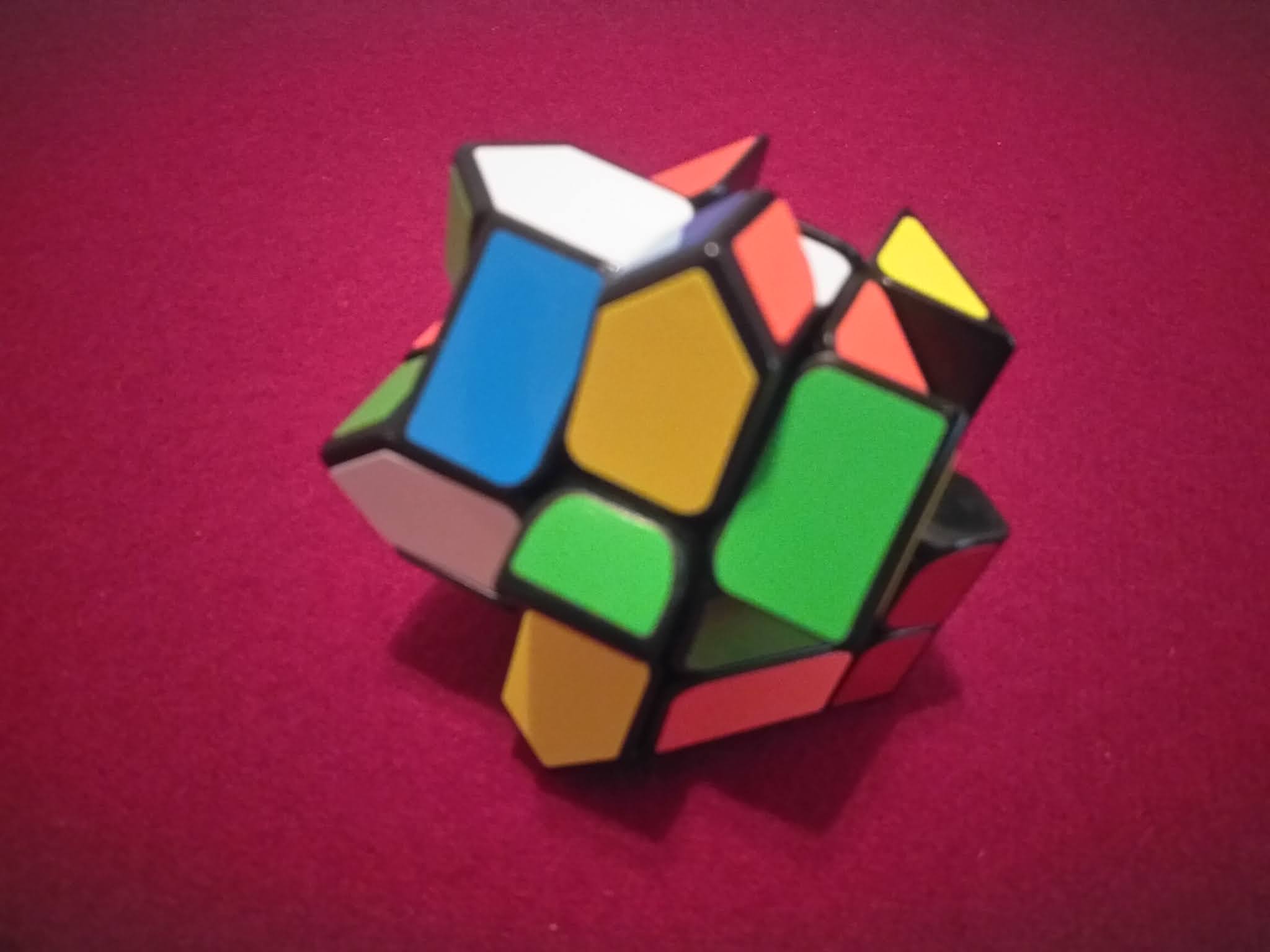
Ball Sudoko Cube

Ball Sudoku Cube

When I think of "Sudoku", I think of grids of numbers but this cube follows a similar principle of having nothing repeating on a face.


The contrast in the photographs between the orange and red pieces is less clear than it is is reality. 

The puzzle turns easily enough. It is not designed for speed cubing, but this is not a puzzle for speed solving.

The puzzle is comprised of the following pieces...

Green: two corners.

Red and magenta: three edges.

White, dark blue, yellow, orange, cyan and black: a centre, an edge and a corner.

Solution

This was not as difficult to solve as I anticipated. Parity odd cases a feature of the solving process but not a significant obstacle.
 
Scrambling the puzzle is a little bizarre, as there are no more than three pieces of the same colour. It is interesting to note that there are only two green pieces, both of them corners. These become important as they can be used as reference pieces between the U- and D-layers. All of the other corner pieces are of one colour.


The way I solved the puzzle is broken down into two phases: solve the edges the solve the corners.

Step 1 - U-Layer Cross

Pick any side, here I have gone with the one with the white centre. Look at the colours on the adjacent edges and choose two opposites. Here I have gone for the two blues. Put their edges on opposite sides of the U-layer. Next put a red and magenta edge on the U-layer to complete the cross. 


Step 2 - D-Layer Cross

This works in a similar way as the U-cross. The colours of the centres on the E-layer that were not solved in step 1 are solved here. Shown below are the orange and yellow edges.


Step 3 - Middle Layer

Finish off the edges by ensuring the edges on the E-layer matching the centres on the U- and D-layers are on opposite sides of the cube.

Orientate the U- and D-layers such that the edges are offset from the matching colours of the centres on the E-layer by a quarter turn. It is possible an odd-parity case could be encountered at this step.

Step 4 - Solve the corners on the U-Face

The colours are green, the centre of the D-face and the centres on the E-layer not already on the U-layer. In this case green, black, yellow and orange. The latter pieces are solved into opposite corners and turned away from their matching colours on the E- and D-layers. It is necessary to ensure that the edges are still in the correct position as previously solved.


Step 5 - Solve the Last Four Corners

Again, a parity odd case may be encountered but this is easily solved.

And the puzzle was solved.

23 January 2021

Hellraiser Cube

The Hellraiser cube is an evil puzzle. At first glance, it looks like opposite faces look the same but there are subtle differences.

I took the precaution of photographing each face, so that I could ensure that I solved to look exactly as it looked when I first removed it from the packaging.


When solving this puzzle, I use the layer method. I solve the pieces as normal, check them against the photographs and swap the ones that are not exactly correct to ensure I return the puzzle to the exact same configuration as when I first removed from the packaging, the lament configuration.


Not I puzzle I play with a lot, but it is a nice one to have in the collection.

14 December 2020

Shepherd Cube

Shepherd Cube

The Shepherd Cube was originally created by Alistair Shepherd with hearts. The current design uses is arrows. It is the ultimate orientation cube, the solved state having arrows all pointed in the same direction on each face.

Shepherd Cubes available for sale are rare, but the stickers are readily available and will be sold by your preferred supplier of custom stickers.

The secret to the puzzle is that one corner has the arrows circling in a clockwise direction...


...the diametrically opposed corner has the arrows circling anti-clockwise.


The consequence of this is that opposite faces have arrows pointing in opposite directions. Knowing this lays the foundation to a solution. These two corners are referred to as "starting corners" in the solution, below.


Solution

This is a challenging puzzle to solve but not as difficult as I anticipated. You do need good spacial awareness to work out where the arrows need to point, and a good understanding of how parity odd-cases can arise and how to deal with them.

Scrambled Shepherd Cube

Step 1: Find a Starting Corner and Orientate the Centres

Find one of the corners where the arrows circle either clockwise or anti-clockwise. This is the starting point and acts as the initial reference point for the next part of the solve.


Step 2: Solve the Edges Adjacent to the Starter Corner

The most difficult aspect of this is finding the correct pieces.

There is now a 2x2x2 solved section.

Step 3: Extend the Solved 2x2x2 Block to a 2x2x3 Block

I prefer to solve the corner first and then add the edges. There are three directions in which to extend. There is a chance that might deliver the right corner in one of the cases.


Step 4: Complete the First Two Layers

There are two directions left into which to expand the solved section. Serendipity is less likely to deliver an easy start to this step.


Step 5: Solve Final Layer Corners

The first corner is the starting corner. The others follow from that one. There is a 50% chance of an parity odd case that needs to be resolved.

Step 6: Solve Final Edges

Finally, solve the edges. It is possible to encounter a parity odd case due to edges being the same.


Parity Odd Cases

Odd parity cases are possible. The centres may be misaligned by a quarter turn, similar to the Void Cube. There are also some edges that are interchangeable. The two starting corners have no orientation, therefore, it is possible to have one cornered rotated out of position.

23 November 2020

Axis Cube

Axis Cube

The Fisher and Windmill cubes don't offer a significantly higher challenge to a person proficient in solving a standard 3x3x3. The only additional aspect is controlling the orientations of the pieces that behave like centres.

The Axis Cube, also known as the Axel Cube, is a significant step up in difficulty. It is still based in the 3x3x3 mechanism but the shape modification makes the puzzle confusing, especially when picking the puzzle up for the first time. Familiarity should be gained with the workings of the puzzle; that is knowing which pieces behave like edges, corners and centres, and understanding what corresponds to a face on a normal cube. Once this hurdle is crossed, it should be easier to solve.


The way the pieces are cut means that a equivalent to a face, as we understand it from a regular cube, is not one colour and not a side of the cube. The picture below shows a "face" rotated by 180°.


Solution

The puzzle shape shifts into a chaotic jumble when scrambled. It can be confusing when figuring out which pieces behave like corners, edges and centres, and how they go together during a solve.


Step 1: Cross

Intuitive step but care needs to be taken to ensure that the centres on the E-layer are orientated correctly as the edges of the cross are put into place.


Step 2: First Two Layers (F2L)

Normal F2L and block building techniques work here as one might expect. Recognition will be an issue at first until familiarity is built up with the shaped pieces.


Step 3: Edges Last Layer

At this point, I see which is easier to solve first, edges or corners. If there is no advantage either way I go for corners. During the solve when I was photographing for it this post, I decided to go with edges, because that was easier.

Step 4: Solve the Corners

Next solve the corners.


Step 5: Orientate Last Layer Centre

The way I solve this puzzle, sometimes leaves the final centre rotated by 180°. So there might be one final step to finish off the solve.


16 November 2020

Windmill Cube

Windmill Cube

After the Fisher cube, the next shape modification I got was the Windmill Cube, also known as the Fenghuolin cube. I call it the Windmill Cube as I am don't know the correct pronunciation of "Fenghuolin".

It is called a Windmill cube because it is possible to create this windmill pattern...

Windmill pattern on windmill cube

I think this is a better puzzle than the Fisher Cube because the edges on the equatorial layer must be orientated correctly during the solve. This does eliminate the possibility of an odd-parity case when orientating the edges on the final layer.


Solution

Solving this puzzle is not difficult for anyone who can solve a standard 3x3x3. The only additional complication, except for solving some edges by shape rather than colour, is the orientation of the centres on the equatorial layer.

The scrambled puzzle shape shifts.


Step 1: Cross

Solve the white edges. Intuitive


Step 2: First Two Layers (F2L)

Normal F2L and block building techniques work here. The only difference is that the edges are solved by shape rather than by colour. It is not difficult once you are used to it.


Step 3: Orientate Yellow Edges

I orientate the final layer edges at this point, to make the puzzle easier to handle for the rest of the solve.


Step 4: Solve Final Layer Corners

Care needs to be taken to avoid rotating the centres on the equatorial layer.


Step 5: Permute Yellow Edges

Again, care needs to be taken to avoid rotating the centres on the equatorial layer.


And there it is solved.


07 November 2020

Fisher Cube

Fisher Cube

The Fisher cube was created by Tony Fisher in the 1980s. If this was not the first shape modification of the cube, it was one of the first. It is not a bad first puzzle to try, if you want to play with something a little different from a standard 3x3x3.

On the U- and D-faces the corners behave like edges and vice versa. On the E-layer, the edges behave like centres and vice versa


Solving the Fisher Cube

Solving a Fisher Cube is not a whole lot different from solving a normal cube. After getting used to the configuration the only additional complication is ensuring the pieces that behave like centres are orientated correctly.

When scrambled, the puzzle shape shifts into a chaotic shape.

Step 1: White Cross

Intuitive. The trick here is to align the pieces that behave like centres on the E-layer.


Step 2: First Two Layers (F2L)

Normal F2L techniques work here. If anything it is slightly easier than on a standard 3x3x3 because the pieces that behave like edges on the E-layer have no orientation.


Step 3: Orientate Yellow Edges

I this stage I orientate the final layer-edges. I leave permuting them until later. I find the puzzle easier to handle with the edges facing the right way.


 There is the additional complication of a possible odd case parity where there could be one or three of the edges rotated. This is very easy to fix: just orientate one of them with an E-layer edge.

Step 4: Solve Corners 

I then do things the old fashioned way of permuting the corners first, before rotating them. I don't know which advanced algorithms affect the centres on the E-layer and which don't. I should much rather keep things simple and use basic algorithms that I know are super cube safe.


Step 5: Permute Edges

The trick here is do this without rotating the pieces that behave like edges on the E-layer. I do it using Sune algorithms.


25 October 2020

TomZ Constrained Cube 90

As the name suggests, each face is constrained to turn by a quarter turn. Constrained Cubes Ultimate and 180 had enough freedom of movement to allow the use of normal algorithms, albeit adapted to contend with the puzzles' turning limitations. This is no longer the case with Constrained Cube 90. Losing the option to execute a Sune algorithm removes many solving options from rotating corners to permuting edges.


Solution

Step 1: Solve the White Edges

Intuitive


I have not figured out if this is the optimum way of solving the puzzle but I solve the white cross in such a way that one edge can be turned in the opposite direction from the other three. For example, one turns clockwise, the others anti-clockwise. This gives me one corner where I can execute a sledgehammer algorithm.

White becomes the bottom face.

Step 2: Solve the E-Layer Edges

Intuitive.


This is extremely fiddly. Moving edges around the puzzle is not easy with turning options so constrained.

Step 3: Orientate the Yellow Edges

I try to do this at the same time as step 2 but it does not always work out.


Step 3: Permute the Yellow Edges

This is a challenging step that requires some thought.


Step 4: Permute the Corners

This is fiddly but not as difficult as as it looks.


Step 5: Orientate the Corners

This step is not that difficult, especially compared with the steps.


This is a very challenging puzzle and, hence, all the more satisfying to solve. It is least an order of magnitude more difficult to solve than its brothers, Constrained Cubes Ultimate and 180. I would advise becoming familiar with at least one of those before tackling this puzzle.