07 November 2020

Fisher Cube

Fisher Cube

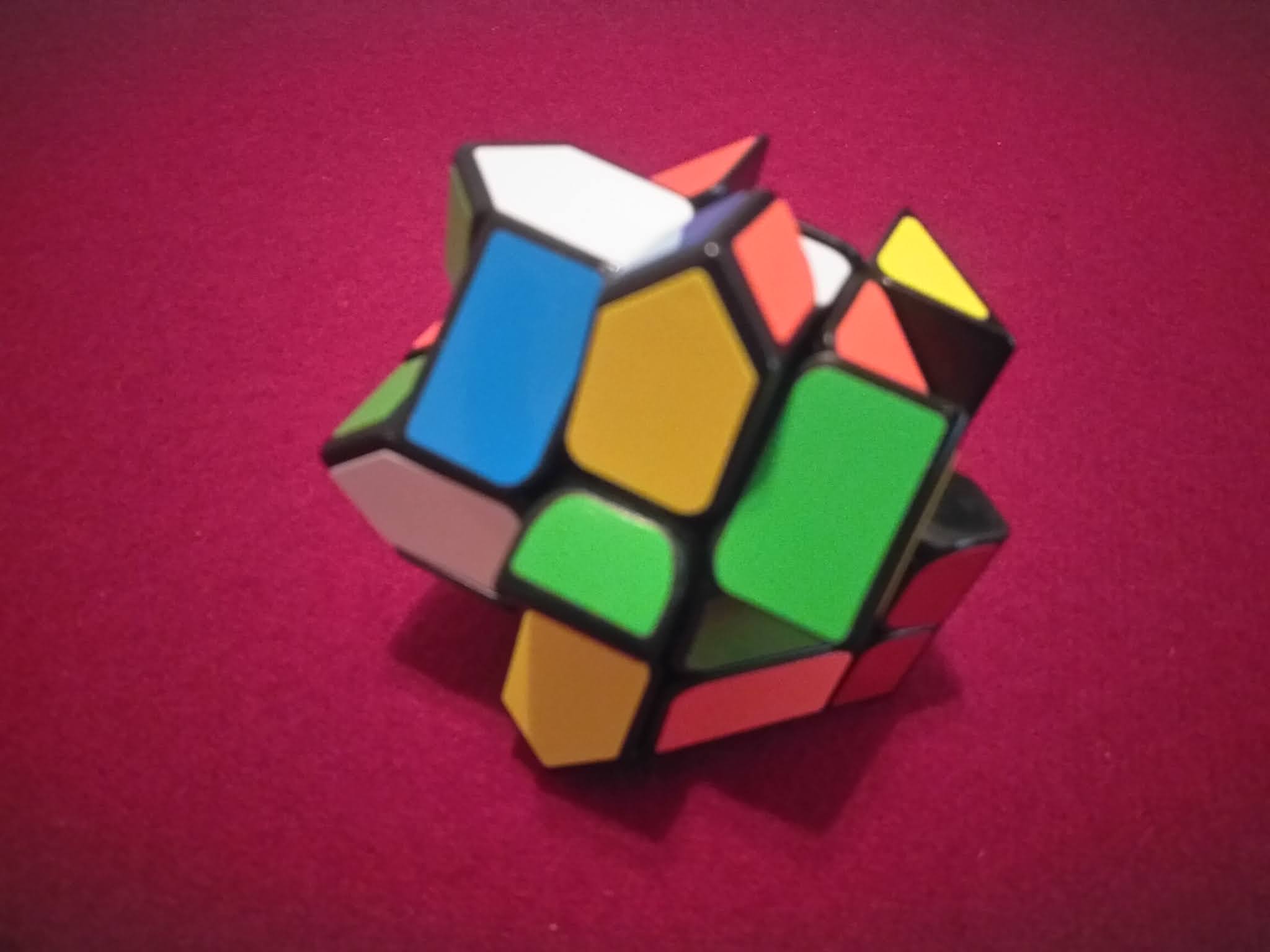
The Fisher cube was created by Tony Fisher in the 1980s. If this was not the first shape modification of the cube, it was one of the first. It is not a bad first puzzle to try, if you want to play with something a little different from a standard 3x3x3.

On the U- and D-faces the corners behave like edges and vice versa. On the E-layer, the edges behave like centres and vice versa


Solving the Fisher Cube

Solving a Fisher Cube is not a whole lot different from solving a normal cube. After getting used to the configuration the only additional complication is ensuring the pieces that behave like centres are orientated correctly.

When scrambled, the puzzle shape shifts into a chaotic shape.

Step 1: White Cross

Intuitive. The trick here is to align the pieces that behave like centres on the E-layer.


Step 2: First Two Layers (F2L)

Normal F2L techniques work here. If anything it is slightly easier than on a standard 3x3x3 because the pieces that behave like edges on the E-layer have no orientation.


Step 3: Orientate Yellow Edges

I this stage I orientate the final layer-edges. I leave permuting them until later. I find the puzzle easier to handle with the edges facing the right way.


 There is the additional complication of a possible odd case parity where there could be one or three of the edges rotated. This is very easy to fix: just orientate one of them with an E-layer edge.

Step 4: Solve Corners 

I then do things the old fashioned way of permuting the corners first, before rotating them. I don't know which advanced algorithms affect the centres on the E-layer and which don't. I should much rather keep things simple and use basic algorithms that I know are super cube safe.


Step 5: Permute Edges

The trick here is do this without rotating the pieces that behave like edges on the E-layer. I do it using Sune algorithms.


25 October 2020

TomZ Constrained Cube 90

As the name suggests, each face is constrained to turn by a quarter turn. Constrained Cubes Ultimate and 180 had enough freedom of movement to allow the use of normal algorithms, albeit adapted to contend with the puzzles' turning limitations. This is no longer the case with Constrained Cube 90. Losing the option to execute a Sune algorithm removes many solving options from rotating corners to permuting edges.


Solution

Step 1: Solve the White Edges

Intuitive


I have not figured out if this is the optimum way of solving the puzzle but I solve the white cross in such a way that one edge can be turned in the opposite direction from the other three. For example, one turns clockwise, the others anti-clockwise. This gives me one corner where I can execute a sledgehammer algorithm.

White becomes the bottom face.

Step 2: Solve the E-Layer Edges

Intuitive.


This is extremely fiddly. Moving edges around the puzzle is not easy with turning options so constrained.

Step 3: Orientate the Yellow Edges

I try to do this at the same time as step 2 but it does not always work out.


Step 3: Permute the Yellow Edges

This is a challenging step that requires some thought.


Step 4: Permute the Corners

This is fiddly but not as difficult as as it looks.


Step 5: Orientate the Corners

This step is not that difficult, especially compared with the steps.


This is a very challenging puzzle and, hence, all the more satisfying to solve. It is least an order of magnitude more difficult to solve than its brothers, Constrained Cubes Ultimate and 180. I would advise becoming familiar with at least one of those before tackling this puzzle.

22 October 2020

TomZ Constrained Cube 180

As the name suggests, all of the sides on this puzzle are constrained to a half turn. It is slightly more difficult than the Constrained Cube Ultimate.


Solution

I did not find it necessary to do anything outlandish to solve the puzzle, following steps that would be familiar to veteran twisty puzzle-solvers.


Step 1: Solve the White Edges

Intuitive. The easiest way is to get the edges into position and then double turn the requisite face to put the edge into position.


I prefer to have the green, orange, blue and red centres fully turned in one direction or the other. The centres can be flipped later on to allow flexibility in turning. I don't worry about the white centre but it will affect the yellow centre later on. If white is fully turned, then the yellow centre will be in the middle of its turning arc when solved and vice versa.


Step 2: First Two Layers

Normal block building or F2L techniques work here but with the need to work around the constrained faces. It is fiddly but I did not find it too difficult.


Step 3: Orientate Yellow Edges

I try to do this at the same time as step 2 but it does not always work out.


Step 4: Solve the Yellow Corners

Normal algorithms can be used here but attention must be paid to how faces turn. Some flipping of centres may be necessary.


Step 5: Permute the Yellow Edges

The final step is a little fiddly but not too difficult.


This is a satisfying puzzle to solve. Compared with the Constrained Cube Ultimate, the loss of freedom on the yellow face has a greater impact than gaining the ability to turn the white face. This makes the puzzle slightly more difficult to solve.


20 October 2020

TomZ Constrained Cube Ultimate

A Constrained Cube is a puzzle where the freedom to rotate the faces is restricted.This cube has five constrained faces. The white face cannot be turned at all, the red and orange faces can be turned by a quarter turn, the blue and green faces by a half a turn and the yellow face is unrestricted.

Turning was is a little stiff on my cube, especially the yellow face. Corner cutting is poor but it is not a puzzle for speed solving so I don't see this as a problem.


Solution

This puzzle is obviously more difficult to solve than a regular one but it is not as difficult as one might imagine. Complete freedom to turn the yellow face is a major boon, while the inability to turn the white face is little or no handicap after the white edges are solved. It is not a problem to flip the orientations of the green and blue centres allowing some flexibility.

Step 1: Solve the White Edges

Intuitive. 

Solve in such a way that it is possible to execute an M-move on the white/green/yellow/blue layer. This makes it easy to flip the green and blue centres later on. Also, solve the green and blue centres such that they can perform a full half turn.


The white face becomes the D-layer.

Step 2: First Two Layers

Block building or F2L techniques work here, but I had to work around the limitations of the constrained faces.


Step 3: Orientate the Yellow Edges

I try to do this at the same time as step 2 but it does not always work out that way.

Step 4: Solve the Yellow Corners

Regular algorithms work here but some inventiveness is necessary to work around the constraints. Obviously, the bottom layer cannot be used to rotate the corners.


Step 5: Permute the Yellow Edges

All that remains is the relatively simple task of putting the yellow edges into their solved positions.

It is a very satisfying puzzle to solve, not as difficult as it looks.

19 October 2020

Katsuhiko Okamoto's Void Cube

Void Cube

When I saw this cube, I just had to have one. It is a very clever piece of design and engineering. It still works like a regular cube but the centre pieces are missing with a void that runs right through the puzzle. It is one Katsuhiko Okamoto's inventions.

Turning is not as smooth as a regular cube and corner cutting is out of the question, due to the way it is constructed.

The puzzle is slightly more difficult than a regular cube due to the lack of a centre piece to act as a reference but this is not much of a hurdle. The more interesting obstacle that this cube introduces is the possibility of a parity issue. If, after solving the top layer, the middle layer is solved next with the bottom layer done last, there is a 50% chance that the middle layer is rotated by 90°. This will prevent the final layer from being solvable.


Parity

To show more clearly the parity issue on the void cube, and the concept in general, please see the picture of the regular cube below. The centres on the middle layer are deliberately mis-solved by 90°, i.e. a qurter turn, out of alignment...


If we then try to solve the yellow face, we discover that it is impossible. To solve this layer, we need to swap two edge pieces...


Regardless of what algorithms are used to move the edges around, at least two will always be in the wrong place. Hence, we have an odd parity case. We can infer from this, that performing a quarter turn on the E-layer is an odd number of edge swaps. Counting them confirms this.

It is obvious on a regular cube but the lack of centres on a void cube makes this potential displacement of the centres invisible.

Solution

To avoid the possibility of an odd parity case rearing its ugly head, I solve this puzzle following the steps below. Obviously, the algorithms that work with a normal cube are applicable here, too.

Step 1 - Solve the White Face

This is an intuitive step.


Step 2 - Solve the Yellow Corners

This can be solved with one only algorithm or at the most two.


Step  3 - Solve the Yellow Edges

Again, nothing special about doing this.

You could solve three edges and then use the fourth one to rotate the middle layer's edges but you will need to ensure that you are rotating them to the correct orientation.

Step 4 - Solve the Middle Layer

Use the gap in the yellow layer to facilitate the process, permuting the middle pieces at the same time if possible.

This is a fun puzzle. It is possible solve using any method used for a standard cube but using an extra algorithm to solve an odd-case parity if it arises. I prefer to solve in such a way to avoid the parity issue.

17 August 2020

Travels of a Rubik's Cube

During my walks that I have undertaken to maintain my physical and mental well-being I have taken a standard 3x3x3 cube and looked for places to photograph it. People who are local to the Blackburn-with-Darwen area might recognise some of the places.

Having a cube in my pocket means I have an excuse for a short breather. I can solve it in random places. Not being a speed cuber means I get a little longer.


09 August 2020

Science not Pseudoscience: A Flat-Earth Challenge

A Flat-Earth Challenge

A common mantra used by subscribers to the flat-Earth concept is "I became a flat-Earther when I could not debunk it". I have yet to see an encompassing flat-Earth model that satisfactorily explains all of the astrophysical phenomena that we observe.


A Flat-Earth Model

There is one heliocentric model, just one. This model is used to describe our tiny piece of the cosmos. It is used to make predictions. It does this very well.
There is no singular and consistent flat-Earth model that can do the same. If the flat-Earth community is genuinely serious in its convictions then it should be able to present a model that explains the Universe we observe and can make accurate predictions. So where is it?

Here is a summary of all of the things that this hypothetical model must include and be able to explain. Just one failure and the model is incorrect and is disproved and discarded.


The Sun

The sun rises in the morning from below the horizon. It travels across the sky at a constant speed and maintains a constant angular size. In the evening, it sets below the horizon. Observers at the same latitude see the sunrise and set at the same time. All observers see the same face of the Sun.

The angular size of the sun does change by a minute amount during the course of the year. It is ever so slightly larger in January than it is in July.

The Moon

The Moon is slightly more complicated. While observers on earth see the same face of the Moon, this is only approximately true. The flat-Earth model needs to explain libration. We can, in fact, see just over half of the Moon's surface from the Earth, with a slightly different portion of the surface being visible depending on its position its orbit. Also, the angular size of the moon varies, giving rise to super moons, etc.

The Moon has phases. All observers on Earth witness the same phase.


Eclipses

There are two types of eclipse. A solar eclipse is when the disc of the sun completely or almost completely obscured. A lunar eclipse is when a shadow passes over the moon preventing the sun from illuminating the moon. The flat-Earth needs to not only explain these two phenomena but also be able to predict when they will occur.


The Celestial Sphere

North of the equator, the sky is seen to rotate in an anti-clockwise direction around the north celestial pole. South of the equator, it rotates clockwise around the south celestial pole. Specific stars are either visible or invisible depending on an observer's latitude. For example, no Southern stars can be seen from the Earth's North pole and Polaris cannot be seen south of the equator.


Forces and the Acceleration due to Gravity (or not-Gravity)

Gravity - throw something up in the air and it comes down again. Something at elevation possesses potential energy that converts to kinetic energy as it falls. Sit down on a chair and you can feel it pressing up against you. There is an acceleration of 9.8 m/s² at the Earth's surface. This drops off with altitude. There is also a slight change depending on latitude.

Tides - the waters of the world's oceans and, to a lesser extent, lakes rise and fall in a predictable pattern based related to the motions of the Sun and Moon in the sky.

Sun and Moon - What holds the Sun and Moon in place and causes their motion across the sky?

Atmosphere - the surface of the earth is covered in blanket that is a mixture of gases, mainly nitrogen and oxygen. The pressure of this mixture of gases decreases with altitude.


Earth's Angular Momentum

The principle of the conservation of angular momentum can be used to show that the Earth possesses angular momentum. In other words, the Earth is rotating. If a flat-Earth model is to pass muster it must explain the Coriolis effect. Equipment such as Foucault's pendulum and a laser gyroscope reveal this rotation, therefore, the flat-Earth model needs to be consistent with these pieces of equipment.


A Map of the World

Finally, we need to see a working map of the whole world. This map must be good enough for use as a navigational aid. All distances between any two locations must be accurate and precise. The flat-Earth maps we usually see are arimuthal equidistant projections. Distances from the pole (or centre) to other places on the mao are all correct, but distances between any two other locations are distorted.


Conclusion

Toppling the heliocentric model will require more than a collection of distorted "black swan" photographs. The flat-Earth community needs to present a singular model of the flat-Earth that is 100% consistent with the reality that we observe and has predictive power. Handwavery and evasion are not going to cut it. If you cannot explain all of the above with your model, your model is incomplete or wrong. Go away and come back when you have one that can.

Once you have succeeded, you can then work on advanced features of the model, such as vulcanism, plate tectonics, earthquake shadows (the ones explained by a hot iron core in the globe model), jet streams, the length of the day changing by a fraction of a second depending on the time of year, and any other phenomena you might wish to tackle.